
How to check a BMW petrol engine’s health
Engine repairs are among the most expensive on any car, and many problems start long before you can hear or feel them. The engine computer measures how evenly each cylinder runs and keeps a history of misfires, timing and temperatures. Here’s what to check, in order of importance, whether you own the car or are thinking of buying one.
Why driving the car won’t tell you
Many engine problems start small: one cylinder doing a little less work than the others, a camshaft that lags behind its target, a mixture the engine keeps correcting. The car still starts, idles and drives normally, so you may not notice anything for a long time. The engine computer measures these things all the time.
What to check first
Depending on the engine, the report shows up to eight engine checks. They don’t all carry the same weight. This is the order to read them in:
- Cylinder smoothness: how evenly each cylinder runs. The most important check.
- Misfire history: the misfires the engine computer stored for each cylinder.
- Camshaft timing (VANOS): whether the camshafts follow their target.
- Valve control (Valvetronic): whether the valve lift follows its target.
- Fuel mixture: how much the engine corrects the mixture.
- Engine temperature history: how warm the oil and coolant have run over time.
The first two show whether the engine runs evenly. The next two cover BMW’s timing and valve systems. The last two add context. Some engines also report injector balance and early-combustion protection, covered further down.
1. Cylinder smoothness
With the engine warm and idling, the engine computer measures how evenly each cylinder helps turn the engine. On a healthy engine, every cylinder sits close to the centre. A cylinder far to one side is working differently from the others.
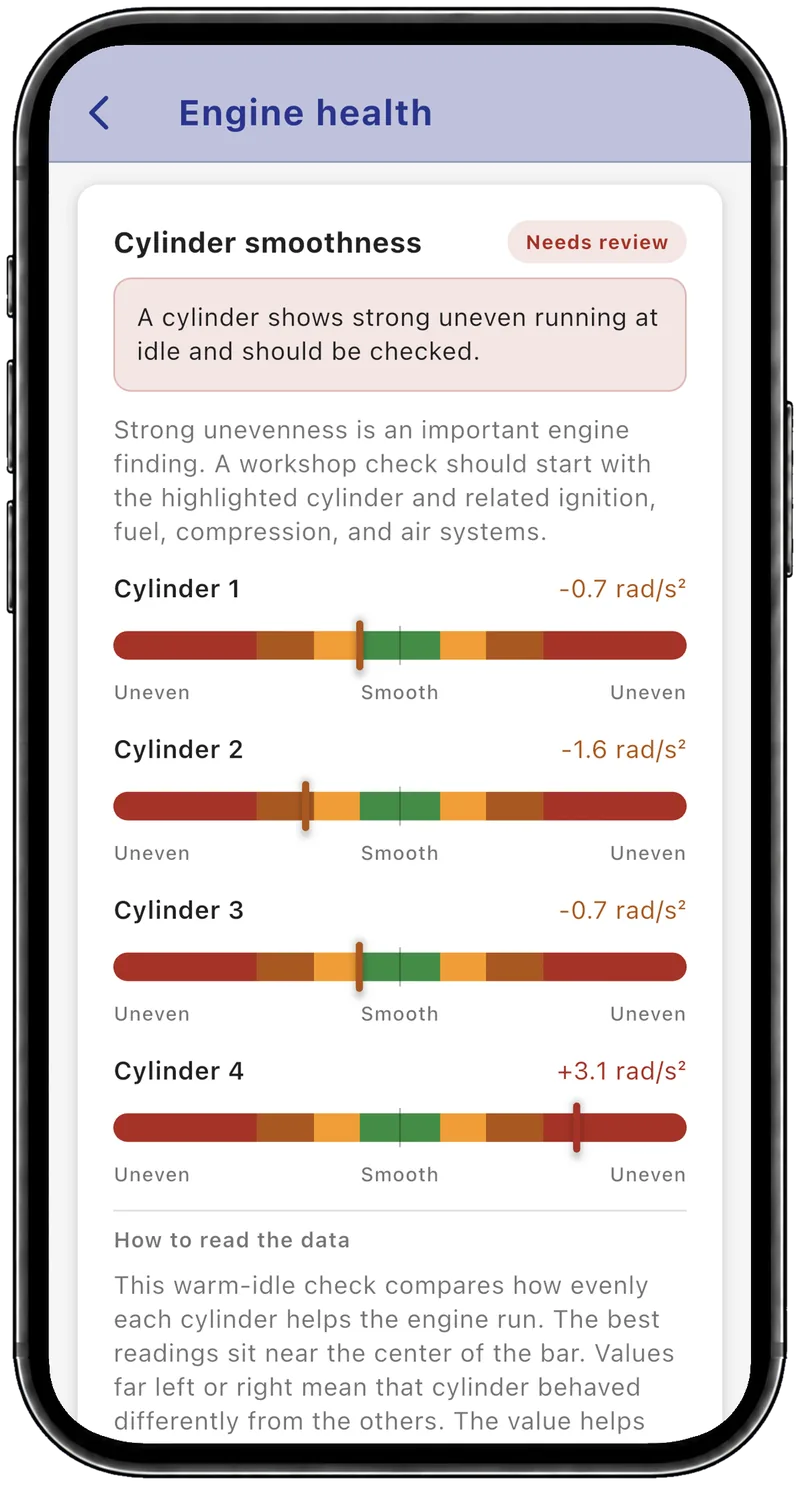
Read this check first. It shows how the engine runs today, not just what happened in the past, and it points to the cylinder to look at. An uneven cylinder can come from ignition, injectors, the fuel mixture, an air leak or low compression. Some of those are cheap to fix, some aren’t. A workshop finds the cause, for example by moving the ignition coil to another cylinder or testing compression.
2. Misfire history
A misfire is a moment when the mixture in a cylinder doesn’t burn properly. The engine computer counts misfires for each cylinder and keeps the count, so this is the engine’s history rather than proof of a problem today. Zero on every cylinder is ideal. One cylinder with a clearly higher count matters more than low, even counts across all of them.
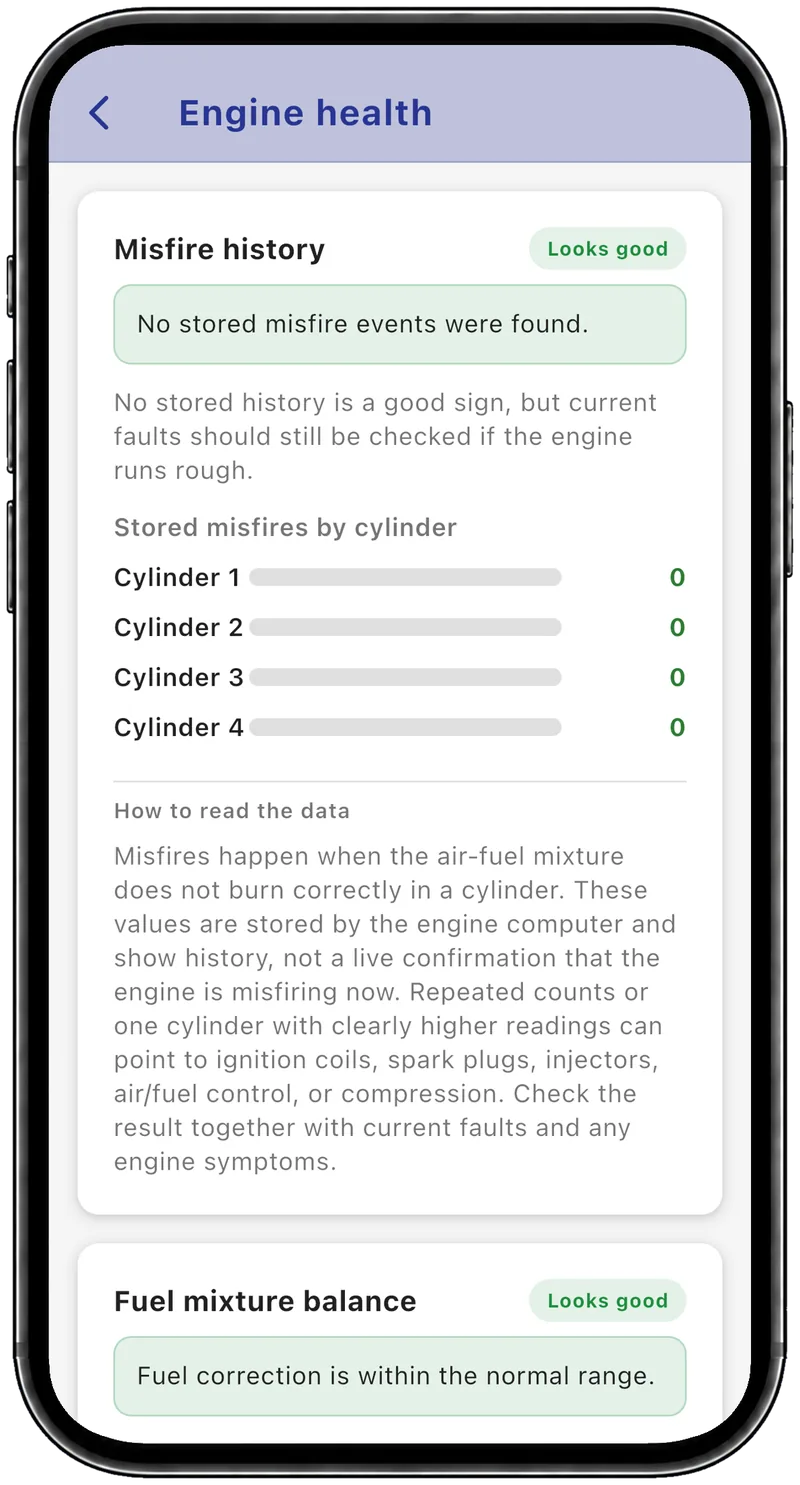
A clean misfire history doesn’t clear an engine on its own. A cylinder can run unevenly at idle without any stored misfires, so read it together with cylinder smoothness.
3. Camshaft timing (VANOS)
BMW petrol engines constantly adjust the timing of their intake and exhaust camshafts, a system BMW calls VANOS. With the engine warm and idling, the report compares the timing the engine computer asks for with what the camshafts actually do. The smaller the difference, the better.
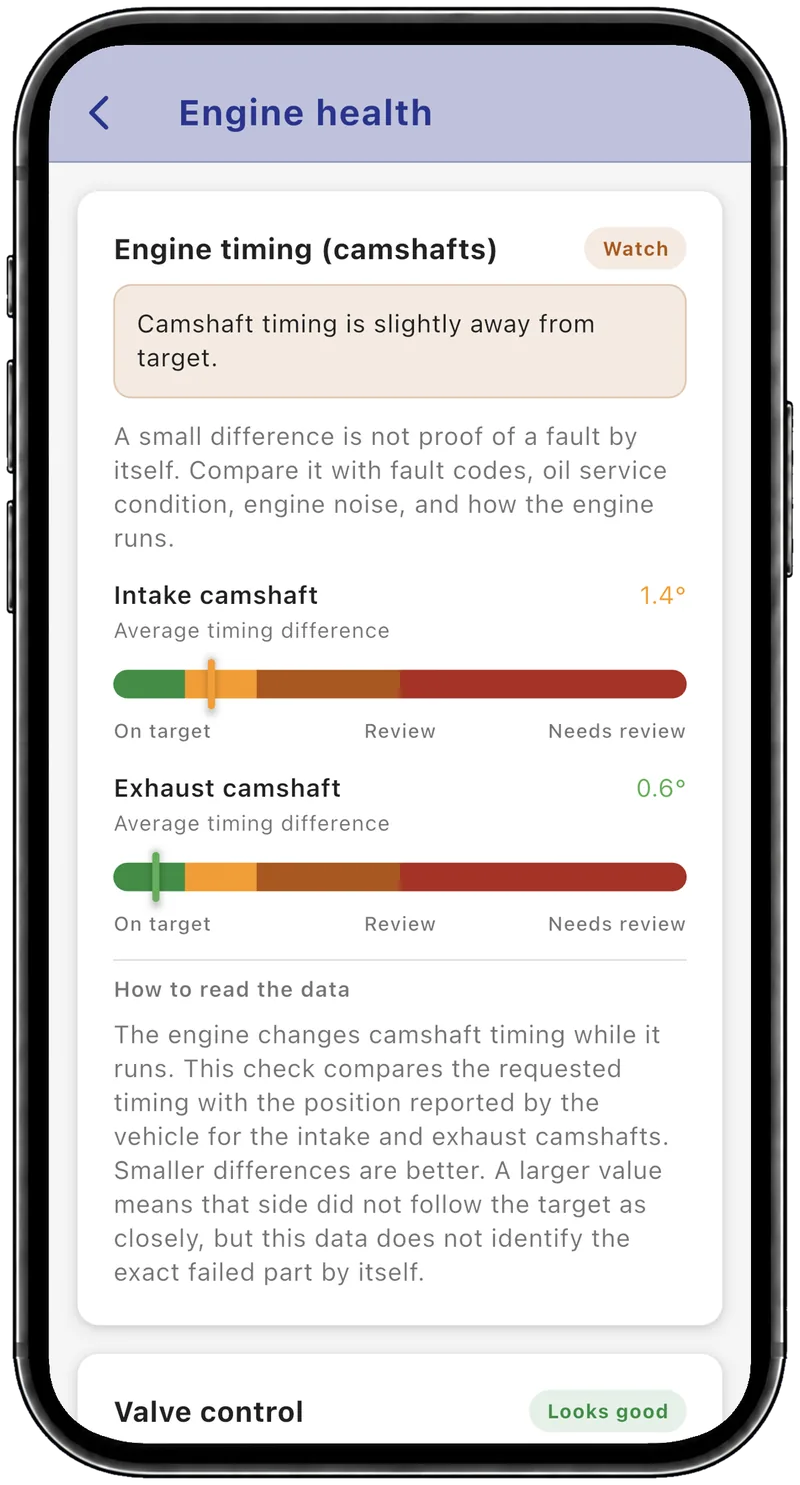
A small difference isn’t proof of a fault. A larger one can point to oil pressure, a timing-control valve, a camshaft adjuster, a sensor or the timing chain. This check doesn’t measure chain wear directly, so also listen for a rattle in the first seconds after a cold start.
4. Valve control (Valvetronic)
Most BMW petrol engines also vary how far the intake valves open, a system BMW calls Valvetronic. The report compares the valve opening the engine asks for with what the car reports, and shows active alerts, stored position errors and emergency operation events.
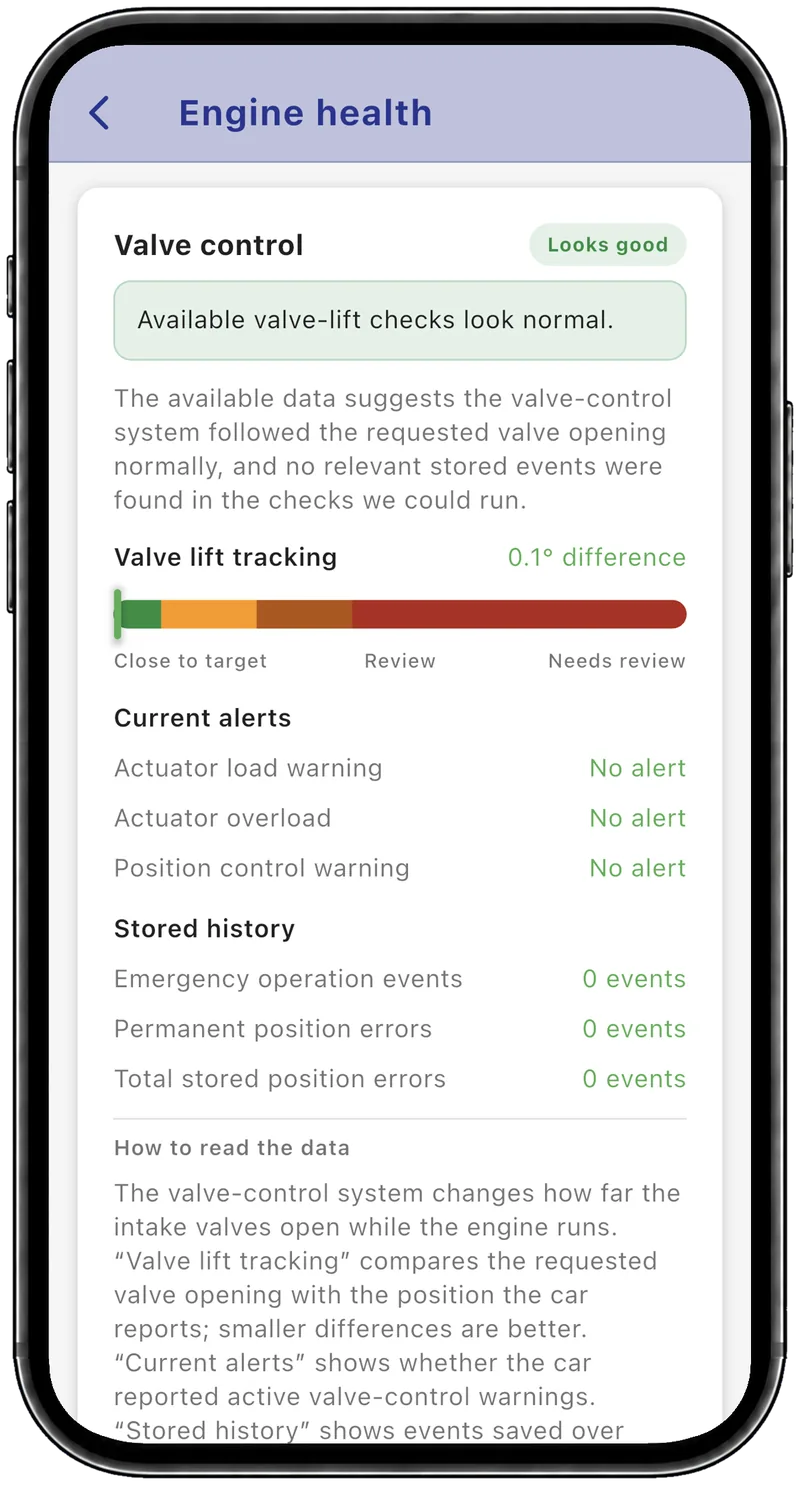
A large difference, an active alert or repeated stored errors can point to the valve-control motor, its position sensor or the linkage. One row on its own is a reason to look closer, not a verdict.
5. Fuel mixture
The engine keeps the air-fuel mixture right by adding or removing fuel. The report shows how much it is correcting. Close to the centre is best.
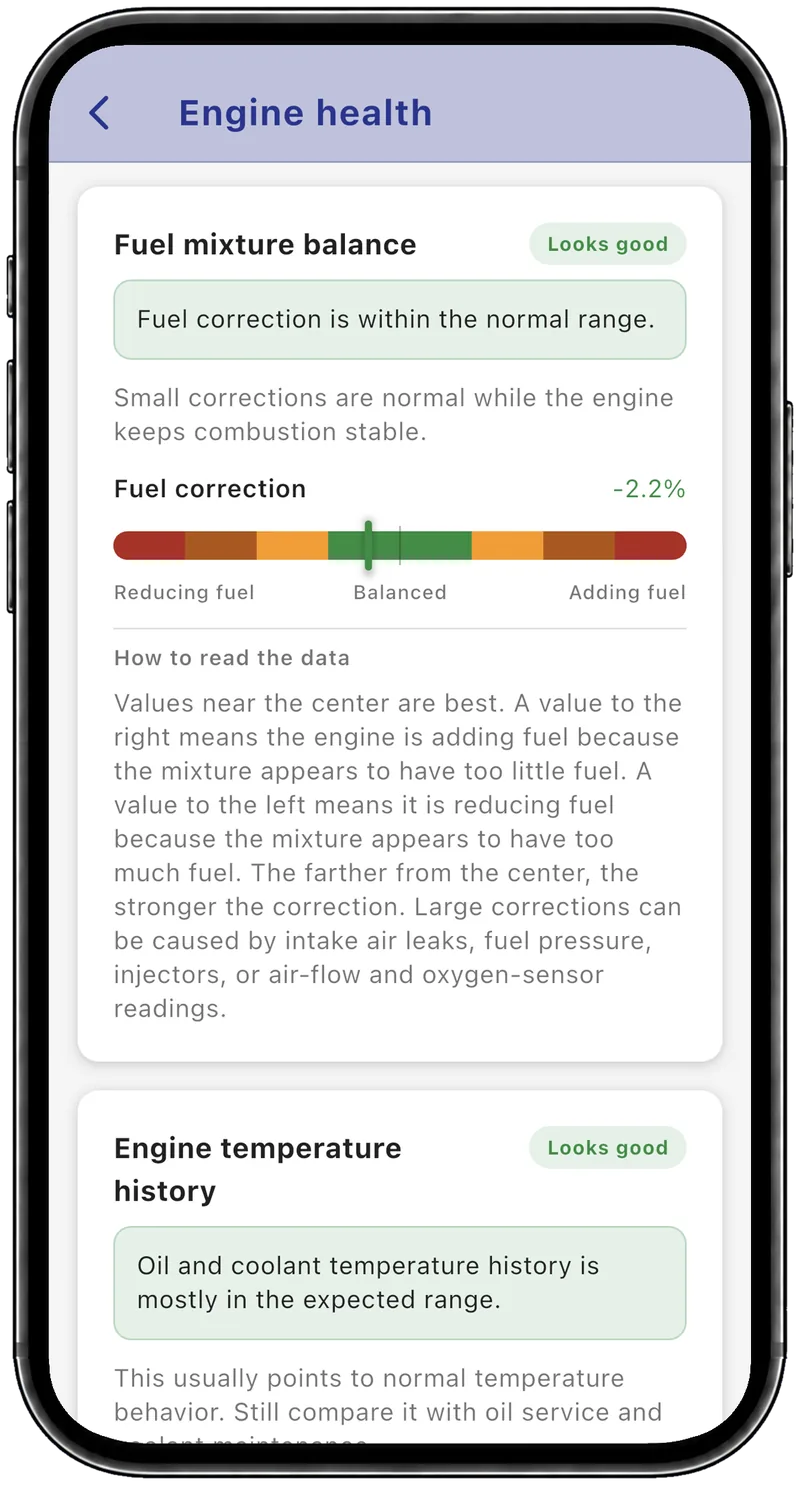
A large correction to the right means the engine is adding fuel because the mixture seems to have too little; to the left, it is removing fuel because there seems to be too much. Large corrections can come from intake air leaks, fuel pressure, injectors, or the air-flow and oxygen sensors.
6. Engine temperature history
The engine computer records how long the oil and coolant have spent in each temperature range. It isn’t a fault check, but it shows how the car has been used.
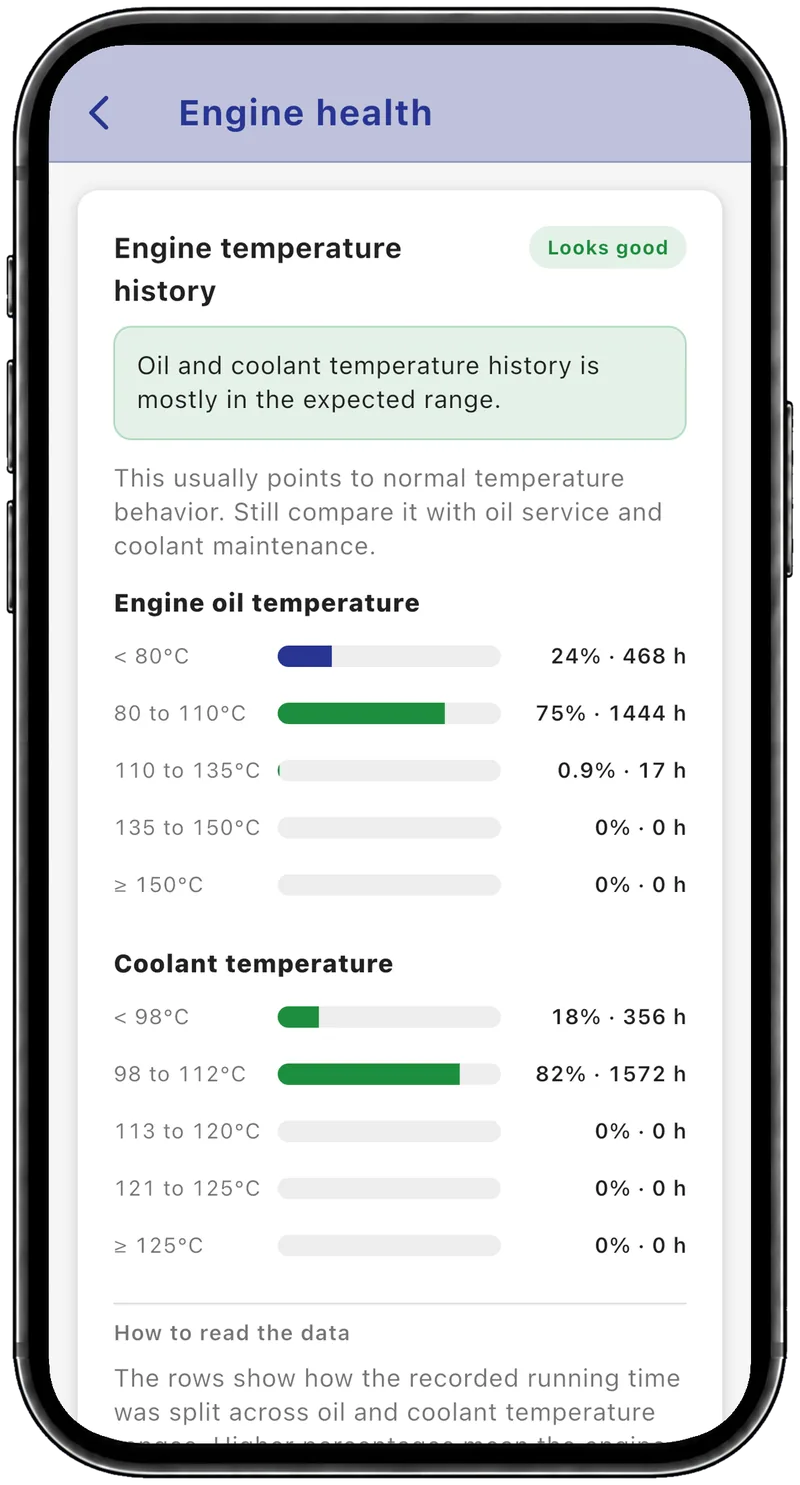
Two patterns are worth a closer look. A lot of time in the hottest ranges can stress the oil, seals, hoses and cooling system. A large share below full oil temperature points to frequent short trips, which are harder on the oil because it may not warm up fully.
Checks on some engines
- Injector balance: the engine adjusts the fuel for each cylinder to keep it running evenly. Small, even corrections are normal. One cylinder needing much more or less fuel than the others, or an injector at its correction limit, can point to a worn injector, fuel pressure or a problem in that cylinder.
- Early-combustion protection: some engines record what they did when fuel burned too early. Extra fuel to cool the combustion is the mildest response and can be linked to fuel quality, the wrong oil, heavy load or tuning. A cylinder switched off, briefly or permanently, is serious and needs a workshop check.
What a reading outside the green can mean
An amber or red reading is a reason to look closer, not proof that the engine is failing. It tells you where to start.
- Run the inspection again after a longer drive. A repeat reading tells you more than a single one.
- Check the fault codes for engine faults, especially for the cylinder or system the reading points to.
- Look at the service history: when the spark plugs and ignition coils were replaced, and how often the oil was changed.
- Share the PDF report with a specialist workshop so they know where to start.
- After a repair, run the inspection again to see whether the reading is back in the green.
What the report can’t tell you
- It doesn’t measure compression, oil consumption or timing chain wear directly.
- It can’t see oil or coolant leaks, worn engine mounts or smoke from the exhaust.
- It shows the engine on the day of the inspection. It doesn’t replace a workshop inspection.
Check it yourself
- Drive for 10–15 minutes so the engine is fully warm.
- Park with the engine idling and plug a compatible OBD adapter into the port under the dashboard.
- Open BimmerInspect and connect to the adapter.
- Run the free inspection. It waits until the engine is warm and idling, then reads the car and shows how many engine checks it completed. On a plug-in hybrid, the petrol engine itself has to be running.
- Unlock the full report to see every reading and what it means.
Wait for the full inspection rather than running a partial one: a partial inspection skips cylinder smoothness, camshaft timing and valve lift. The free inspection shows whether your car provided engine data before you pay anything. The full report is a one-time purchase for that car, with no subscription. BimmerInspect works with selected BMW and MINI models on the F and G platforms; which engine checks are available depends on the engine. Which adapter do I need?
On a plug-in hybrid, the same inspection also checks the high-voltage battery. How to check a BMW plug-in hybrid’s battery health
If you’re buying
- Ask the seller not to start the car before you arrive, so you can hear the cold start.
- Ask when the spark plugs and ignition coils were last replaced, and how often the oil was changed.
- Ask whether the timing chain, VANOS or Valvetronic system has been worked on, and whether the engine has been tuned.
- If a reading is in the red, have the car inspected by a specialist before you decide.
Frequently asked questions
Is one uneven cylinder serious?
Not necessarily. It tells you where to look. The cause can be a worn spark plug or ignition coil, which is a routine repair, or something mechanical, which costs more. A workshop can tell you which.
Why does the engine have to be warm?
Cylinder smoothness, camshaft timing and valve lift are measured at warm idle. A cold engine runs differently, so cold readings would be misleading.
How often should I check my engine?
Whenever the engine feels or sounds different, before a long trip and around a service. Comparing readings over time tells you more than a single check.
Which cars does it work on?
Selected BMW and MINI models with petrol engines on the F and G platforms. Which engine checks are available depends on the engine. Diesels have different checks, such as the particulate filter (DPF) and the EGR valve.
What do I need?
A phone with BimmerInspect and a compatible OBD adapter. No workshop visit and no account.
What is free, and what do I pay for?
Running the inspection is free and shows how many engine checks were completed. The readings, the verdicts and what they mean are in the full report, which you unlock with a one-time purchase for that car. There is no subscription.
Start with a free inspection
BimmerInspect reads this information from your car with an OBD adapter and your phone. The inspection is free; the results are in the full report, a one-time purchase.
iPhone first. Android is planned.