
How to check a BMW automatic gearbox
A gearbox repair is one of the most expensive repairs on any car. An automatic gearbox keeps adjusting how it engages each of its clutches, and it stores those adjustments. Here’s how to read them, what they can mean and what they don’t prove, whether you own the car or are thinking of buying one.
Why a test drive won’t tell you
An automatic gearbox corrects for its own wear. When a clutch inside starts to engage a little later or harder than it should, the gearbox control unit changes the pressure and timing so that shifts stay smooth. A gearbox that is already hiding wear can therefore shift well on a short drive, especially once it is warm. The corrections it has learned are stored in the gearbox control unit.
What adaptation values are
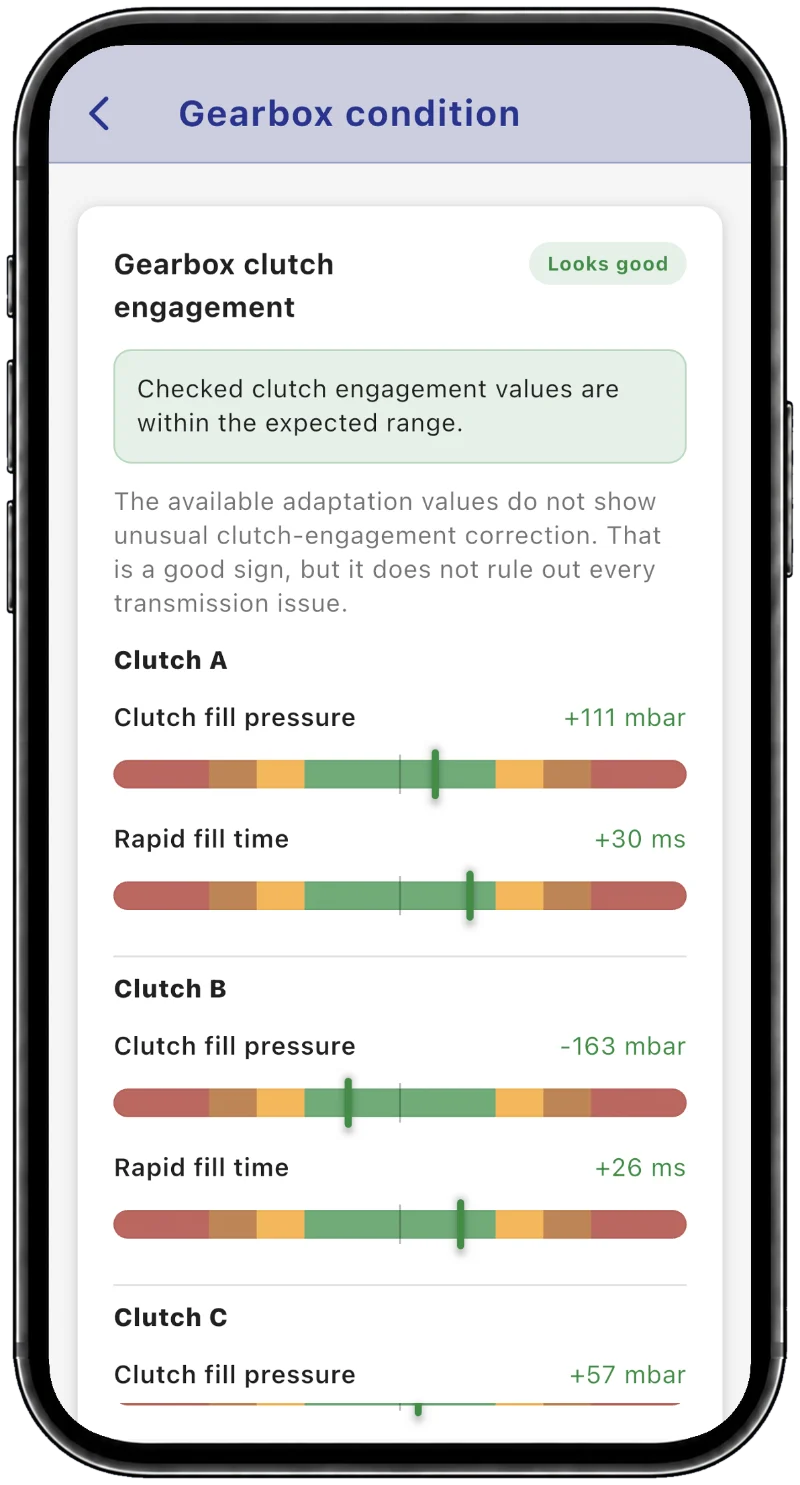
An automatic gearbox changes gear with clutches that oil pressure presses together. Each one has to grip at the right moment and with the right force. The gearbox control unit watches every shift and fine-tunes this for each clutch. These learned corrections are called adaptation values.
Values near zero are expected. Small corrections are normal and change over time. A large correction means the gearbox has had to move far from its starting point to keep shifts smooth. That is worth a closer look.
Clutch fill pressure and rapid fill time
BimmerInspect reads two adaptation values for each clutch. The report labels the clutches A to E. Some gearboxes also report C0 and TCC, where TCC is the torque converter lock-up clutch.
- Clutch fill pressure: how much the gearbox raises or lowers the pressure while it fills the clutch with oil, in millibar (mbar).
- Rapid fill time: how much the gearbox lengthens or shortens the quick-fill stage before the clutch starts to carry the load, in milliseconds (ms).
A plus or minus sign shows which way the gearbox corrects. What matters most is the size of the correction: −600 mbar is as far from zero as +600 mbar.
Gearbox oil temperature history
Depending on the gearbox, the report also shows how long the gearbox oil has spent in each temperature range. It isn’t a fault check, but it shows how hard the gearbox has worked over time, which a single test drive can’t.
Heat is one of the main things that ages gearbox oil. Oil that often runs very hot wears out sooner and protects the clutches and the parts that control them less well. On a healthy gearbox, most of the time sits in the normal warm range, with little or none in the hottest ranges.
This helps in two ways. It shows how the car was used: towing, mountain roads, track days and a lot of hard driving all push the oil temperature up. It also puts the clutch values in context. If a gearbox that has often run hot also shows a strong correction, the condition of the oil and when it was last changed matter even more. Heat can also come from a cooling problem, low oil or a slipping gearbox, so a lot of time in the hottest ranges is worth mentioning to a specialist.
What a strong correction can mean
A value outside the green is a reason to look closer, not proof that the gearbox is failing. It tells you the gearbox has to correct one clutch more than usual. Possible reasons include:
- Wear of the clutch itself.
- Oil condition: old oil, low oil, or oil that has often run hot.
- Pressure control: the valves that set the oil pressure for each clutch.
- Software: the gearbox software version. A BMW dealer can check whether an update is available.
A strong correction doesn’t prove that the gearbox is about to fail, that it needs a rebuild, or which part is at fault. A single reading also can’t show how fast things are changing. Several readings over time tell you more.
What to do next
- Check the fault codes for gearbox faults. They are in the same report.
- Notice how the car shifts. Delayed, harsh or slipping shifts matter more alongside a high value.
- Look at the service history: when the gearbox oil was last changed, if ever, and whether the gearbox software was updated.
- Share the PDF report with a gearbox specialist so they know which clutch to look at.
- Run the inspection again after a few weeks of normal driving, or after a repair or gearbox oil change, and compare.
What the report can’t tell you
- Adaptation values can be reset, for example after a software update, a gearbox oil change or a repair. The gearbox then learns again from the start, so low values on a high-mileage car can mean a recent reset rather than a gearbox in perfect shape.
- It only covers supported gearboxes. Clutch values come from ZF automatic gearboxes. Dual-clutch gearboxes and the automatic gearboxes in MINI and front-wheel-drive-based BMW models, including their xDrive versions, don’t provide them.
- It can’t see the condition of the oil, leaks or worn gearbox mounts, and it can’t hear noises.
- It shows what the gearbox control unit has learned. It doesn’t replace a check by a gearbox specialist or a look inside the gearbox.
Check it yourself
- Drive the car for a while and notice how it shifts, especially at low speed and in the first minutes after a cold start.
- Park with the engine idling and plug a compatible OBD adapter into the port under the dashboard.
- Open BimmerInspect and connect to the adapter.
- Run the free inspection. It reads the car and shows whether the gearbox checks were completed.
- Unlock the full report to see every clutch value, its label and what it means.
The adaptation values are stored in the gearbox control unit, so they don’t depend on a warm engine. If you also want the engine checks, wait for the full inspection rather than running a partial one. The free inspection shows whether your car provided gearbox data before you pay anything. The full report is a one-time purchase for that car, with no subscription. BimmerInspect works with selected BMW and MINI models on the F and G platforms; clutch values are available on supported ZF automatic gearboxes. Which adapter do I need?
On a petrol car, the same inspection also checks the engine. How to check a BMW petrol engine’s health
If you’re buying
- Ask when the gearbox oil was last changed, and ask for the invoice.
- Ask whether the gearbox has been repaired, reset or updated, and when. Values close to zero on a high-mileage car can mean a recent reset.
- On the test drive, pay attention to shifts at low speed, the first shifts after a cold start and any delay when you select D or R.
- If a value is marked “Needs review”, or several are marked “Needs attention”, have the gearbox checked by a specialist before you decide.
Frequently asked questions
My clutch A is at −600 mbar. Is that a problem?
It’s well away from zero, which means the gearbox corrects that clutch more than usual. On its own, that doesn’t mean the clutch is failing. Notice how the car shifts, check the fault codes and find out when the gearbox oil was last changed, then read the value again after some normal driving. The maker’s limits differ from clutch to clutch, so a gearbox specialist can tell you whether the value is unusual for clutch A on your gearbox.
Will it explain shift shocks at low speed or a hum when cold?
Partly. The report shows whether the gearbox is correcting a clutch strongly, which can go with harsh or delayed shifts. It can’t hear noises, and it can’t rule out other causes such as engine or gearbox mounts, the oil level or the gearbox software. A workshop can check those.
Do the values reset after a gearbox oil change or a software update?
They can. A workshop can reset the adaptation values after a gearbox oil change, a repair or a software update, and the gearbox then learns again. When you compare readings, it helps to know when the last reset was.
Which cars does it work on?
Selected BMW models on the F and G platforms with a supported ZF automatic gearbox, such as the eight-speed ZF 8HP. Dual-clutch gearboxes, manual gearboxes and the automatic gearboxes in MINI and front-wheel-drive-based BMW models don’t provide these clutch values. The free inspection shows what your car provides before you pay anything.
What do I need?
A phone with BimmerInspect and a compatible OBD adapter. No workshop visit and no account.
What is free, and what do I pay for?
Running the inspection is free and shows whether the gearbox checks were completed. The clutch values, their labels and what they mean are in the full report, which you unlock with a one-time purchase for that car. There is no subscription.
Start with a free inspection
BimmerInspect reads this information from your car with an OBD adapter and your phone. The inspection is free; the results are in the full report, a one-time purchase.
For iPhone and iPad. Android coming later.