
How to check if a BMW’s control units were replaced
Many of a BMW’s control units store the VIN of the car they belong to, the date they were made, or both. When these don’t line up across the car, a unit was most likely replaced at some point. That can be a routine repair, a retrofit or accident repair, so it’s worth knowing which unit it was and why.
Why a replaced unit is hard to spot
A control unit from another car looks exactly like the original, and once it is set up, the car drives normally. Accident damage can be repaired well enough that the bodywork shows nothing, and invoices go missing. The units themselves still keep a record of where they came from.
Each control unit keeps its own identity
When a car is built, many of its control units are programmed with its VIN, and many also store their build date: the day the unit itself was made. On a car that still has its original units, every stored VIN is the same and the build dates sit close together, because the parts were made within a few months of each other, shortly before the car.
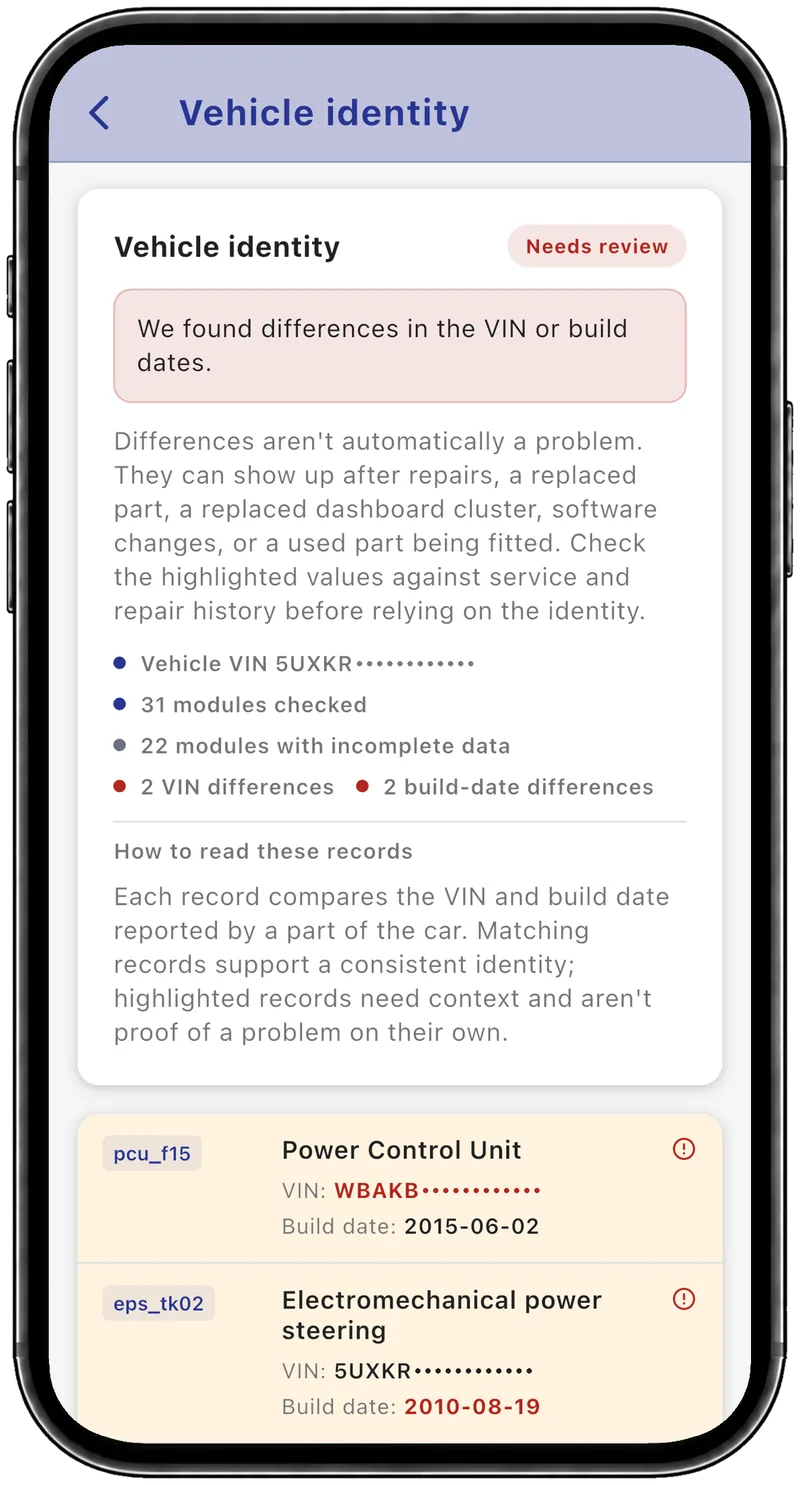
How the report compares them
- VIN: each unit’s VIN is compared with the car’s VIN. A unit with a different VIN is highlighted.
- Build date: the report finds the six-month period that holds most of the build dates and highlights any unit made earlier or later.
Not every unit stores both values, so a dash in the list is normal. In the example above, 22 of the 31 modules are missing one of them.
Reading the highlighted units
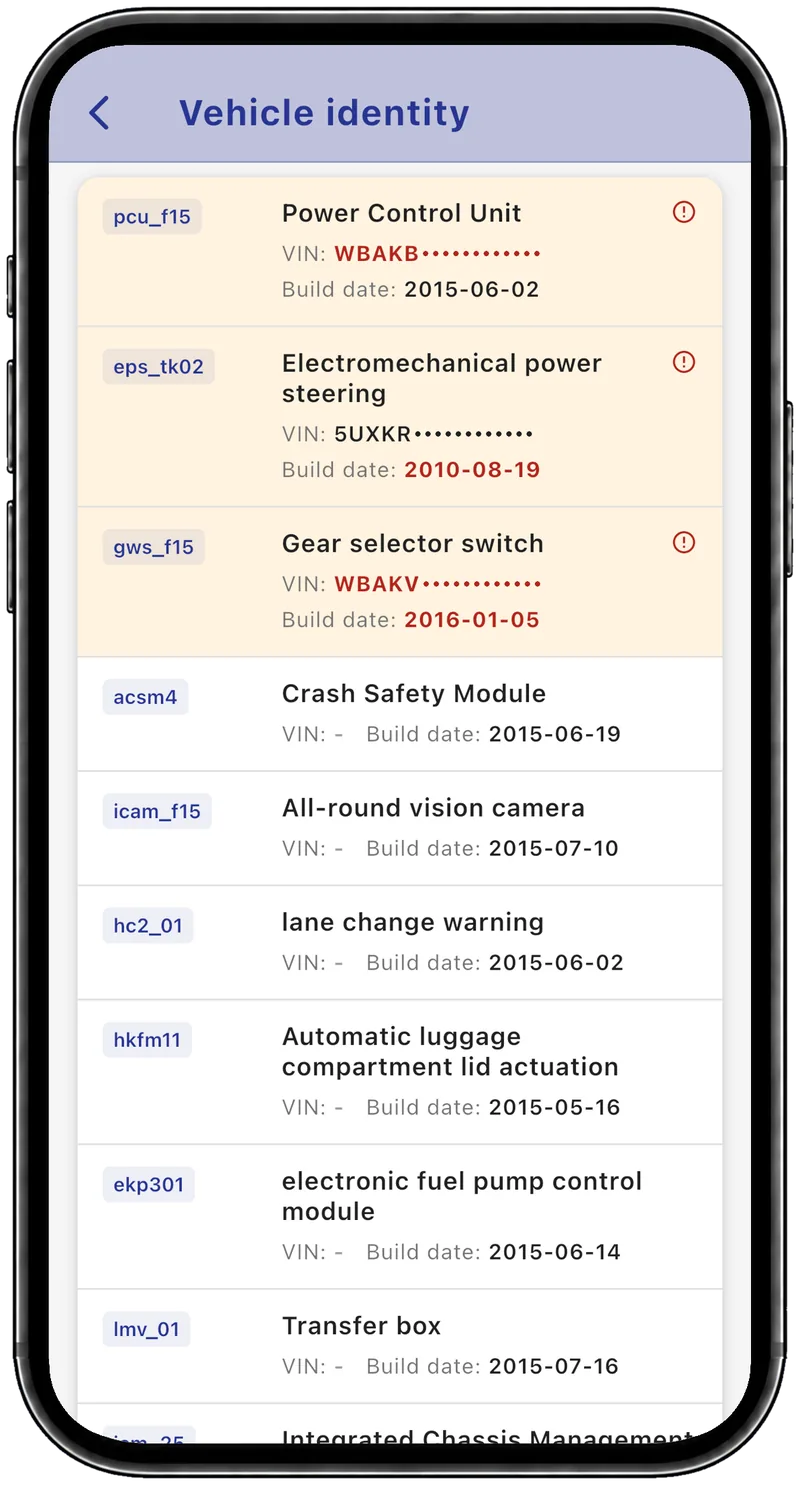
Together, these three units show the patterns you’ll see most often:
- Another car’s VIN, build date in line: the unit most likely came from a similar car of the same age and still carries that car’s VIN.
- Another car’s VIN and a build date out of line: the unit came from another car, made at a different time.
- This car’s VIN, build date out of line: this unit was most likely replaced too. When a workshop sets up a replacement unit, it can write the car’s VIN into it, but the build date stays with the part.
A matching VIN doesn’t always mean a unit is original. A build date far from the rest can be the only sign that it was replaced.
What a difference can mean
A highlighted unit is a reason to ask questions, not proof of a problem. Possible explanations include:
- A repair with a new part, for example under warranty. New parts are usually made later than the car.
- A used part from another car, a common way to repair an older car.
- A retrofit, such as a newer screen or an extra feature taken from another car.
- Accident repair, where several units in the damaged area were replaced.
- A replaced instrument cluster, which can also affect the mileage. How to check if a BMW’s mileage is real
If you own the car, the same check can show whether a workshop fitted a new part or a used one: a new part usually has a later build date, while a used one often keeps another car’s VIN.
The pattern matters more than one unit
One replaced unit usually has a simple explanation. Look more closely when:
- Several units from the same area of the car differ, for example the front radar, camera and headlight units. That can point to a front-end repair.
- Safety units are among them, such as the crash safety module (airbag control unit) or driver assistance sensors. Ask who fitted and set them up.
- The bodywork shows signs of repair, such as uneven panel gaps or paint that differs from panel to panel. Used BMW inspection checklist
What the report can’t tell you
- It shows a different VIN or build date, but not why or when a unit was replaced.
- It can only compare units that store a VIN or build date. Many replaced parts, such as body panels, have no control unit at all.
- It doesn’t replace a bodywork inspection by a specialist after a suspected accident.
Check it yourself in about five minutes
- Plug a compatible OBD adapter into the port under the dashboard.
- Start the car, open BimmerInspect and connect to the adapter.
- Run the free inspection. It reads every system that responds and shows whether it collected VIN and build-date data.
- Unlock the full report to see the VIN and build date of every unit, with any differences highlighted.
The free inspection shows whether your car provided identity data before you pay anything. The full report is a one-time purchase for that car, with no subscription. BimmerInspect works with selected BMW and MINI models on the F and G platforms; how many units report a VIN or build date depends on the model and equipment. Which adapter do I need?
If you’re buying
- Ask whether any control units have been replaced and why, and ask for the invoices.
- Ask whether the car has had accident damage, and where it was repaired.
- Ask whether anything was retrofitted, such as a screen, lights or driver assistance features.
- If several units from the same area, or any safety units, are highlighted, have the bodywork inspected by a specialist before you decide.
Frequently asked questions
Does a different VIN mean the car was in an accident?
No. Used parts are also fitted after ordinary faults and for retrofits. A single highlighted unit is a question to ask. Several highlighted units in the same area of the car are a stronger sign of accident repair.
Why do some units show a dash?
Many control units store only a build date or only a VIN. A dash is normal and doesn’t mean anything is wrong.
Can a replaced unit show this car’s VIN?
Yes. When a workshop sets up a replacement unit, it can write the car’s VIN into it. That’s why the report also compares build dates, which stay with the part.
Which cars does it work on?
Selected BMW and MINI models on the F and G platforms. How many control units report a VIN or build date depends on the model and equipment.
What do I need?
A phone with BimmerInspect and a compatible OBD adapter. No workshop visit and no account.
What is free, and what do I pay for?
Running the inspection is free and shows whether VIN and build-date data was collected. The VIN and build date of every unit, and any differences, are in the full report, which you unlock with a one-time purchase for that car. There is no subscription.
Start with a free inspection
BimmerInspect reads this information from your car with an OBD adapter and your phone. The inspection is free; the results are in the full report, a one-time purchase.
iPhone first. Android is planned.