
How to check a BMW plug-in hybrid’s battery health
The high-voltage battery is one of the most expensive parts of a plug-in hybrid, and driving the car tells you almost nothing about it. The car itself keeps an estimate of how much capacity is left.
Why driving the car won’t tell you
A plug-in hybrid with a worn battery starts, drives and charges like any other. The electric range on the dashboard is only an estimate that changes with temperature, driving style and climate control, so it can hide a tired battery. The real answer is stored in the battery’s own control unit.
Battery health in one number
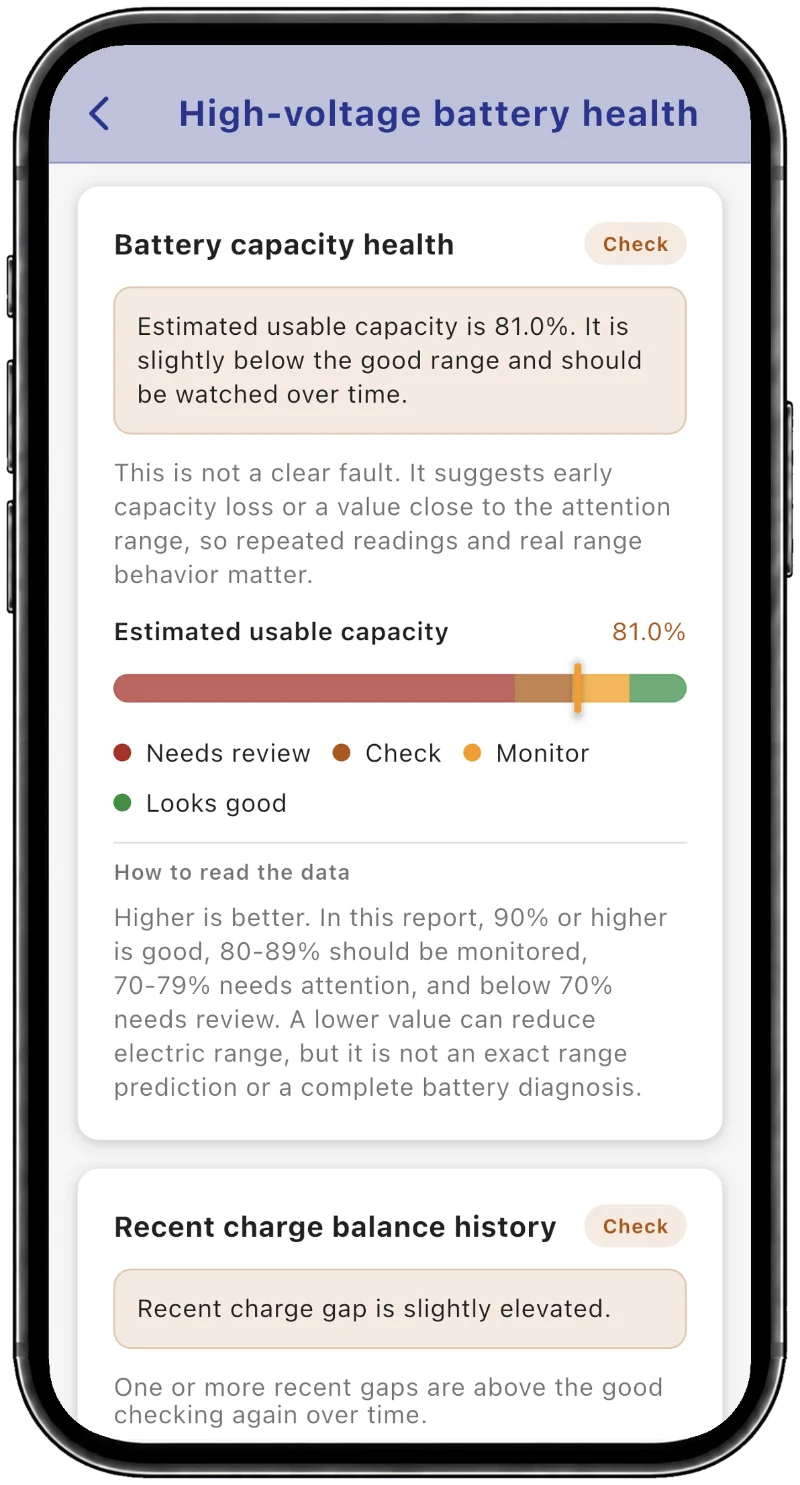
State of health (SOH) compares how much energy the battery can store today with how much it stored when new. 100% is a new battery. Every lithium-ion battery slowly loses capacity with age and use, and heat and long periods at a full charge speed this up.
How to read the number
Some loss of capacity is normal, so read the number together with the car’s age and mileage. As a rough guide:
- Around 90% or more: the battery has lost little of its capacity.
- Around 80%: the battery has clearly aged, and the electric range is noticeably shorter than when new.
- Well below 80%: worth a closer look, especially before you buy.
The battery above is at 81%, just above that mark. Electric driving still works, but a full charge takes you less far than when the battery was new.
Balance matters too
A high-voltage battery is made of many cell groups working together. If some drift apart, the weakest group limits the whole pack. Depending on the car, the report compares the charge level, voltage and capacity estimates of these groups and shows the gap between the lowest and highest. The smaller the gap, the better.
A gap slightly above the good range, such as 1.7%, isn’t a fault on its own, but it is worth checking again later.
What a low reading can mean
A low or borderline value is a reason to look closer, not proof that the battery is failing. It is the car’s own estimate and can shift between readings, so a trend tells you more than a single number.
- Compare it with a second reading after a normal drive and a charge.
- Check the fault codes for high-voltage battery or charging faults.
- Check the service history for battery repairs or software updates.
- Check whether the high-voltage battery warranty is still valid. Terms depend on the market and model year.
Check it yourself in about five minutes
- Plug a compatible OBD adapter into the port under the dashboard.
- Start the car, open BimmerInspect and connect to the adapter.
- Run the free inspection. It reads the car and shows how many battery checks it completed.
- Unlock the full report to see the state of health, the balance checks and what they mean.
The free inspection shows whether your car provided battery data before you pay anything. The full report is a one-time purchase for that car, with no subscription. Battery checks work on supported BMW and MINI plug-in hybrids and electric cars; what each car reports depends on the model. Which adapter do I need?
On a plug-in hybrid, the same inspection also checks the petrol engine. How to check a BMW petrol engine’s health
If you’re buying
- How often was the car charged, and did it often sit fully charged or completely empty for long periods?
- Has the high-voltage battery ever been repaired, replaced or updated?
- Is there a service record or battery test from a BMW dealer?
- What electric range does the car show after a full charge, and in what weather?
Frequently asked questions
Is a reading of around 80% bad?
Not necessarily. At around 80%, the battery stores about a fifth less energy than when it was new. The car still works as a plug-in hybrid, with less electric range. Treat it as a number to watch over time.
Does the electric range on the dashboard show battery health?
Only roughly. The range estimate depends on temperature, driving style, climate control and recent trips, so it can look fine even when capacity is down.
Which cars does it work on?
Supported BMW and MINI plug-in hybrids and electric cars. Which battery checks are available depends on the model.
What do I need?
A phone with BimmerInspect and a compatible OBD adapter. No workshop visit and no account.
What is free, and what do I pay for?
Running the inspection is free and shows how many battery checks were completed. The state of health, the balance checks and what they mean are in the full report, which you unlock with a one-time purchase for that car. There is no subscription.
Start with a free inspection
BimmerInspect reads this information from your car with an OBD adapter and your phone. The inspection is free; the results are in the full report, a one-time purchase.
For iPhone and iPad. Android coming later.